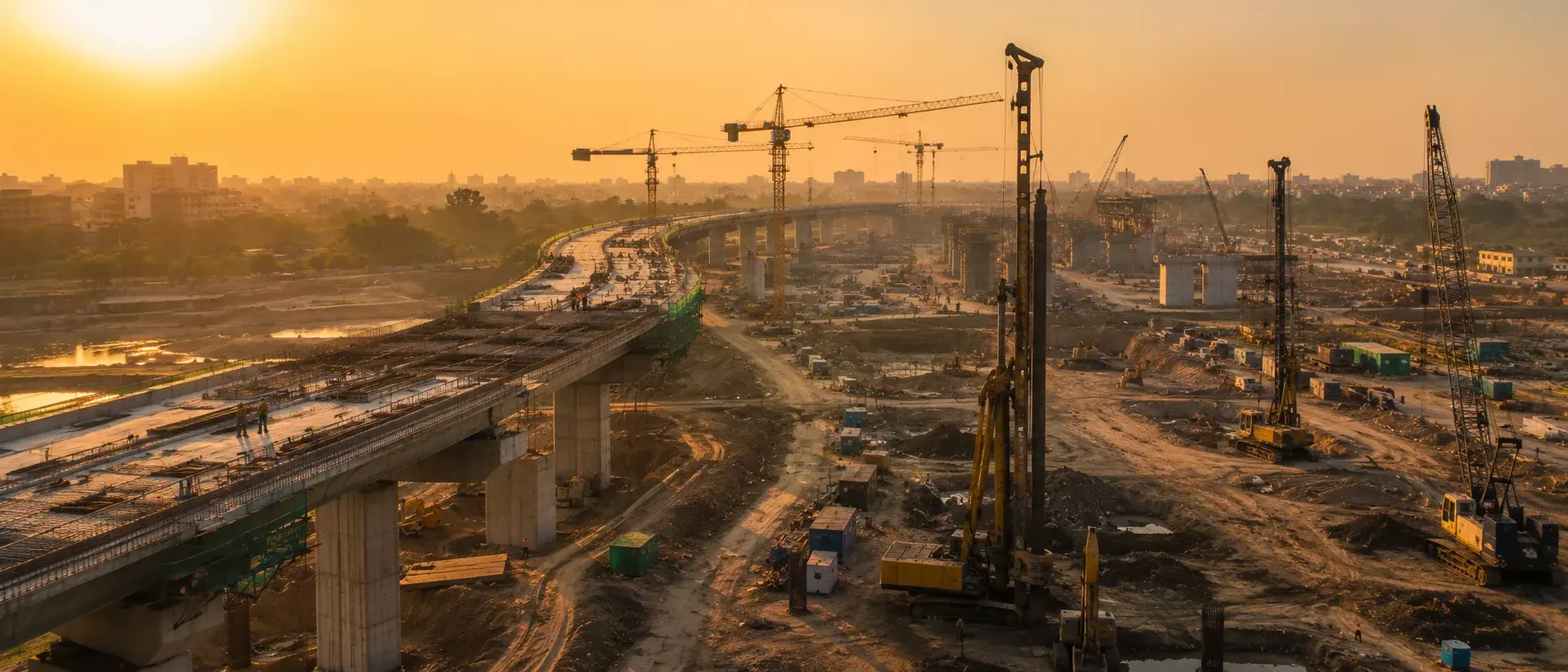
Major bridges and highway structures cannot be built on weak surface soils. Pile foundations transfer loads to competent strata at depth. This guide explains how bridge pile foundations are designed, installed, and tested.
Why Bridges Need Deep Foundations
A major bridge transfers enormous loads — dead load of the deck and superstructure, live load from vehicles and rail, dynamic loads from wind and seismic activity — through its substructure (piers and abutments) to the ground. Near-surface soils are rarely competent enough to accept these loads within allowable settlement limits.
Pile foundations solve this by driving or boring load-bearing elements down through weak upper soils to dense sand, gravel, rock, or cohesive soil strata at depth — where both the bearing capacity and settlement characteristics are acceptable.
Types of Piles Used in Bridge Foundations
Bored Cast-in-Situ Piles
The most common pile type for major bridges in India. A borehole is drilled to design depth using rotary equipment, a reinforcement cage is lowered in, and concrete is poured from bottom up (tremie method for wet bores).
Advantages: Can be installed to great depth (25 m+), suitable for all soil conditions, minimal vibration, high-capacity options available (large-diameter piles 1.0–1.5 m dia).
Driven Precast Concrete Piles
Factory-cast reinforced or prestressed concrete piles driven into the ground using impact or vibratory hammers.
Advantages: Factory quality control, fast installation, good for granular soils, minimal concrete waste on site.
Limitations: High vibration impact, depth limited by pile capacity and equipment, not suitable for hard rock or boulders.
Sand Piles and Stone Piles
Used for ground improvement and load distribution rather than direct structural load transfer. Common in DFC and embankment foundation applications.
Pile Design: The Engineering Process
A well-designed bridge pile foundation goes through these stages:
1. Geotechnical Investigation
Borehole drilling and soil testing at each pier location to establish soil profile, strength parameters, and groundwater conditions.
2. Load Assessment
Structural engineers calculate factored vertical, horizontal, and moment loads at each pile cap from the superstructure analysis.
3. Capacity Analysis
Geotechnical engineers calculate pile end-bearing capacity and skin friction along the pile shaft for the site-specific soil profile, using IS 2911 methods or pile load test calibration.
4. Settlement Prediction
Settlement analysis confirms that predicted pile group settlement is within the allowable limits for the superstructure type.
5. Construction Method Selection
Equipment selection, installation sequence, concreting method, and quality control procedures are specified.
Pile Load Testing: Verification of Design
No pile foundation programme is complete without load testing. Indian standards (IS 2911 Part 4) and project specifications typically require:
Static Load Test: Pile loaded to 2× working load using kentledge or anchor system. Settlement monitored at each load increment. Confirms both capacity and settlement behaviour.
Dynamic Load Test (PDA): Strain gauges and accelerometers on pile head measure force and velocity during driving. Pile capacity derived by CAPWAP analysis. Faster and more economical than static test for production piles.
Pile Integrity Test (PIT/CSL): Confirms structural integrity of installed pile concrete — identifies necking, cracking, or voids.
Parkline Infra's Bridge Pile Foundation Experience
Parkline Infra has delivered pile foundation works for major bridges under:
- • L&T Construction — EDFC and WDFC projects (UP, Rajasthan, Gujarat, Haryana, Maharashtra)
- • GMR Infrastructure — EDFCCIL bridge and pile foundation works in Uttar Pradesh
- • Dilip Buildcon — Highway bridge pile foundations in Uttar Pradesh
- • Rays Power Infra — Solar plant pile foundations in Karnataka and Uttarakhand
Each programme is executed with full pile load testing, integrity verification, and construction records — because a bridge foundation is not somewhere to compromise.
Glossary
- • RUB — Railway Under Bridge: underpass beneath a railway embankment
- • ROB — Road Over Bridge: bridge carrying road over railway
- • EDFC/WDFC — Eastern/Western Dedicated Freight Corridor
- • IS 2911 — Indian Standard for pile foundation design and construction