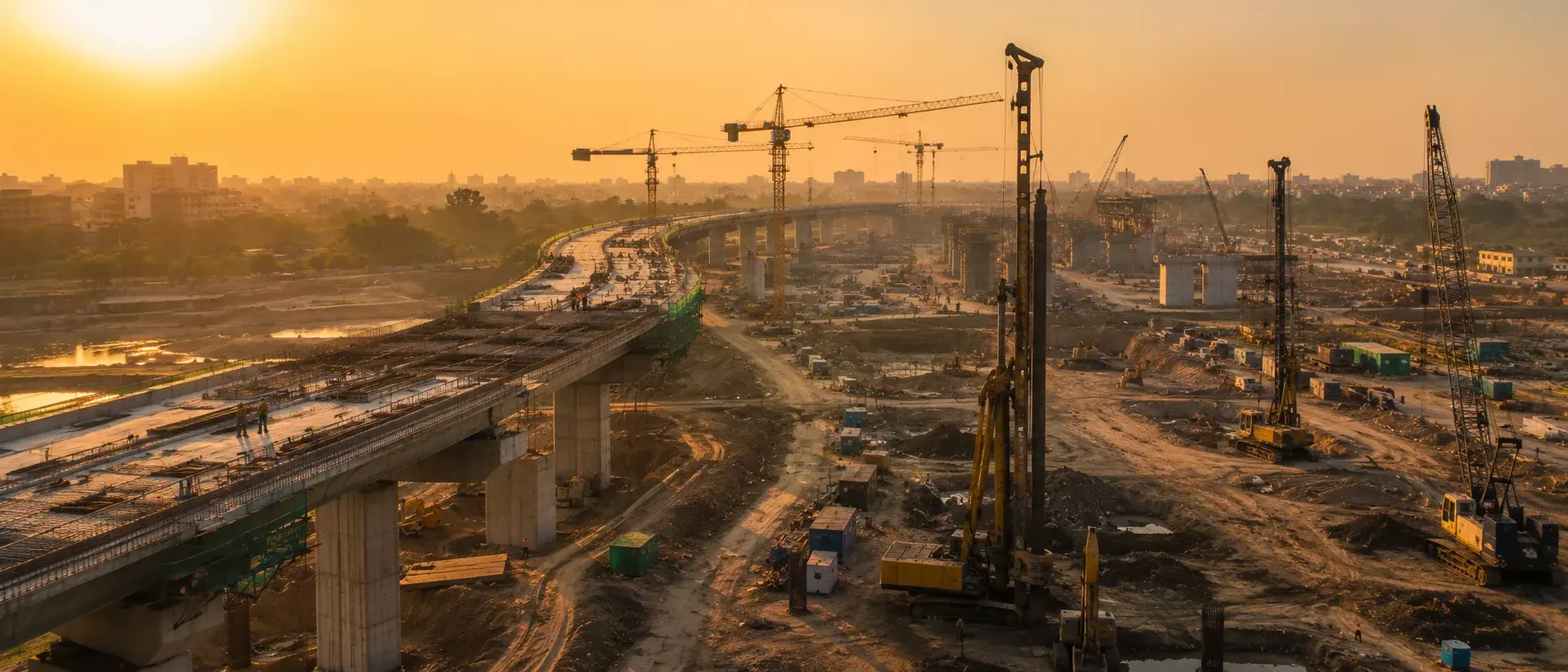
Infrastructure projects that go wrong are almost never the result of a wrong design. They are the result of wrong execution. Here is why disciplined execution is the most important variable in infrastructure procurement — and how to evaluate it.
The Fundamental Misconception in Infrastructure Procurement
Many project owners — public and private — treat infrastructure procurement as a commodity exercise. If the specifications are detailed enough, any contractor who agrees to meet them at the lowest price is equivalent to any other.
This is wrong. And it is expensive.
The reason infrastructure projects fail — over cost, over time, or structurally — is almost never inadequate specification. It is inadequate execution against that specification. The gap between what a contractor says it will do and what it actually does on site is where project risk lives.
What Execution Discipline Actually Looks Like
Execution discipline is not about doing things correctly when conditions are easy. It is about doing things correctly when conditions are difficult — when the ground is worse than expected, when materials are delayed, when the client changes scope, when monsoon arrives three weeks early.
Disciplined contractors maintain quality systems, safety protocols, and programme discipline under pressure. Undisciplined contractors cut corners under pressure — and those corners are cut in the ground, in the concrete, in the steel, where they are hardest to see and most dangerous to ignore.
Signs of execution discipline in an infrastructure contractor:
- • Structured quality management systems with documented ITP (Inspection and Test Plans)
- • Third-party pile load testing, material testing, and structural inspection — not avoided as cost, embraced as assurance
- • Safety record and safety culture — HSE incidents are programme risks, not just liability events
- • Programme management with milestone tracking and proactive delay escalation
- • Client communication cadence — problems reported early, with solutions proposed, not reported after they become crises
- • Reference projects where clients will confirm delivery against original programme and cost
Why Lowest Bid Is a Risk Amplifier
A contractor who bids too low has two options: accept the loss, or find ways to reduce cost on site. The ways to reduce cost on site are:
- • Use cheaper materials (non-compliant concrete mixes, lower grade rebar)
- • Skip testing (pile load tests, material certificates)
- • Reduce supervision (fewer qualified engineers on site)
- • Compress timeline (skip curing time, rush concrete pours)
- • Subcontract to lower-cost, lower-capability suppliers
All of these options transfer risk to the project owner. The savings on the contract price become a fraction of the eventual remediation, delay, or failure cost.
The Risk Management Case for Parkline Infra
Parkline Infra Private Limited positions itself explicitly as a risk management partner, not a cost minimiser. This is not marketing language — it reflects how the company makes decisions.
AA Class Classification: Not just a credential. It is evidence of the financial stability to absorb programme risk without cutting corners.
In-house capabilities: Ground improvement equipment, fabrication workshops, RRV manufacturing — these in-house capabilities reduce the contractor's dependence on the subcontractor market, which is where execution risk concentrates.
Client retention: The fact that L&T Construction has engaged Parkline Infra for multiple projects across different corridors (EDFC/WDFC) and different work types (piles, drainage, maintenance, RRV fabrication) is evidence of programme-level delivery, not one-off success.
Founder oversight: In a company the size of Parkline Infra, the founder's personal involvement in project oversight is a quality signal. Mr. Gajanand Sharma's deep technical background in geotechnical engineering and project management is not a boardroom credential — it is a site-level capability.
A Framework for Evaluating Contractor Risk
When evaluating infrastructure contractors, consider:
Conclusion
Infrastructure is not just construction. It is risk management. The contractor you choose either manages that risk — through discipline, capability, and financial stability — or transfers it back to you. Choose accordingly.
Parkline Infra Private Limited delivers engineering strength and execution certainty across ground improvement, pile foundations, bridge construction, steel fabrication, building construction, and railway infrastructure. Contact us to discuss how we manage the risk on your next project.